
The Hard Part of an Agent Loop Isn't the Loop
In 2026, Boris Cherny, the creator of Claude Code at Anthropic, told an interviewer he had stopped prompting the model by hand: “I don’t prompt Claude anymore… My job is to write loops,” (OfficeChai, 2026). For about a week, a lot of people took that clip as proof the loop was the hard part. I’d been running one since March 2026, and the viral cut skipped the only part that’s actually hard.
The Bootstrap Problem
I first ran into this pattern under a different name, a “Ralph Wiggum loop,” well before Cherny’s clip made the rounds. Since then, Claude Code shipped a /loop command and the Copilot app added an “Automation” tab, both chasing the same idea. In my experience both are generic and limiting: wiring up a real loop trigger in Copilot CLI still means writing the agent charters, the skills, the routing, from nothing, for every project you point it at.
The job hasn’t just gained a loop step, it’s split in two: writing code that builds the product, and writing the code that lets a team of agents build the product.
Squad Is the Bootstrap Layer
Squad is my answer to that problem.

View on GitHub
A few commands scaffold an agent charter, then you hand each agent the skills it needs for the tool at hand, and it’s ready to run. The charter can use any thematic cast: on this site, mine is Ocean’s Eleven, Danny, Rusty, Tess, Linus, Basher. Another project of mine runs a Bleach-themed cast instead. The names are cosmetic, but naming the agents makes it faster to tell, months later, exactly which one owns a given call, since decisions get logged by name, not by session.
How the Loop Actually Runs
A loop.md file is the instruction sheet the orchestrating agent reads at the start of every cycle. It can run self-directed or off a GitHub issue queue, and agents can file their own issues when they find work outside the current task. That queue also shows me what the team’s been doing: I scan recently opened and closed issues instead of a separate dashboard. It also changes what “done” means: this repo’s weekly retro went from six straight cycles at 0% completion on its action items, written as markdown checklists, to 100% the moment those items became GitHub issues instead. A markdown checklist is a wish; an issue is a queue with a status.
My own loop runs 30 minutes on, 10 minutes off. The break matters more than it sounds: cut it under 10 minutes and a subagent still finishing background work collides with the next cycle, and the first chunk of that cycle gets spent untangling files two agents both touched. Every iteration opens by running the build and test script; if it’s not clean, fixing that is the only priority until it is.
From there, the orchestrator checks GitHub issues and routes whatever it finds by domain: coding work to the coding agent, design work to the design agent. The failure mode I actually hit was never a wrong routing call, it was over-spawning, agents starting work nobody asked for because they start too eagerly. If the queue is empty, the agents run a full pass of the codebase, flag anything missed earlier or newly relevant, and file it as an issue for the next cycle instead of just fixing it unsupervised.
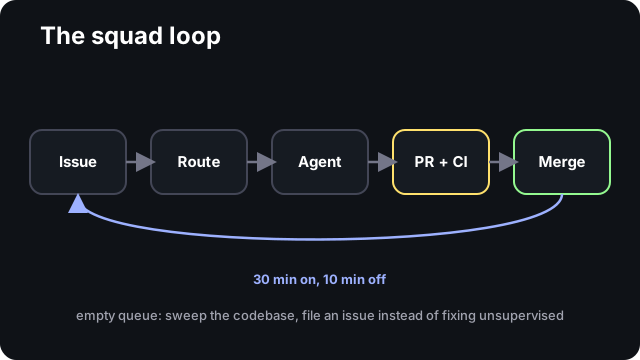
Issue in, agent out: routing and the CI gate are the only steps a human designed by hand.
The one piece I added on top of stock Squad is a loop.sh wrapper, a fixed set of parameters alongside loop.md that lets the loop use git to resume cleanly after a timeout instead of losing whatever a subagent was mid-file on.
Where It Falls Short
Squad is built around Copilot, and I haven’t found a good port to Claude Code or Codex, which is probably why the repo has fewer stars than the tool deserves. Subsquads, multiple sub-teams working the same goal in parallel, sound like more throughput; in my use they slowed things down instead, and I can’t fully rule out that I set them up wrong. Loops also still drift when nobody’s watching, which is the whole subject of How to Avoid Sloppy Loops, a longer answer than fits here.
The viral clip had the direction right, but the charters, the routing, and the ten minutes of silence between cycles took longer to get right than the prompt or model.
Sources
- Boris Cherny, quoted in OfficeChai, “I Now Just Write Loops To Prompt Claude Code”, retrieved 2026-07-07
Yashas is a game streaming engineer at Xbox Cloud, ex-AAA game developer, and indie iOS builder. Find more at Puzzle Quest Games.